
As given by Section 10 of Indian Contract Act, 1872
There are two ways to discriminate elements.
One given by Sec. 10 of Indian Contract Act, 1872
There are two ways to discriminate elements.
One given by Sec. 10 of Indian Contract Act, 1872
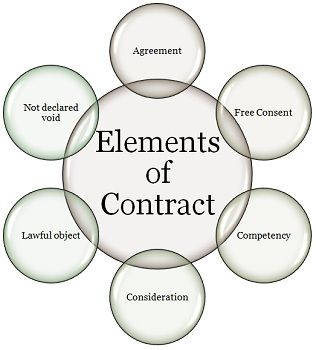 1) Agreement
2) Free consent 3)Competency of the parties
4) Lawful consideration
5) Legal object
6) Not expressly declared to be void.
And second not given by Sec. 10 but still useful
1) Two Parties
2) Intention to create legal relationship
3) Fulfillment of legal formalities
4) Certainty of meaning
5) Possibility of performance
click here - https://contractualrelation.blogspot.com/2020/03/the-indian-contract-act-1872-per-icai.html
And second not given by Sec. 10 but still useful
1) Two Parties
2) Intention to create legal relationship
3) Fulfillment of legal formalities
4) Certainty of meaning
5) Possibility of performance
Essential
element of contract not express in sec.10 of contract
act, but important in contract.
1) Two
parties:-
A single /one party
cannot making
/doing a contract with himself. So for at least .One gives the offer becomes offeror and another accept this offer becomes offeree.
2) Create
legal relation:-
For making a contract there must be legal relation between the parties
and this legality is decided by law and in this domestic type of agreement not
form a contract there must be an existence of commercial agreement for not
making the contract void.
3) Legal
formalities:-
In
certain cases there must be an agreement in writing if party makes contract in
orally in certain cases this agreement
/contract becomes void;
eg. Agreement of insurance and agreement of immovable
property are example of this.
4) Performance of contract:-
In the contract is not performed or
impossible to perform this type of contract becomes void and if the performance
is possible than the contract is said to be valid
Eg:- A is a
tantrik baba ,B comes into A’s contract and said if he gave him a degree of B.COM. and MBA .he gave him 5 lakhs Rs. And tantric baba acceptes this
contract,which is impossible and becomes void.
5) Certainty of meaning:-
Agreement must be certain and uncertain.
Eg:-A agree
to give 10 tons oil to B. this is a uncertain agreement in this oil quality or
specification not described.
#As per
sec.10 of contract act these elements as follow.
1)Agreement/offer
and acceptance:-
As per sec.2(e) of contract
Act,1872"Every promise or a set of promises, forming consideration is known as
agreement and when the proposel is made to whom signifies his assent ‘ to
do’ or ‘not to do’ something if accepted
,when accepted becomes promise.
2)
Consideration :-
When a party
gives something to other party and other party return consideration to same
party in terms of money and something this is known as ‘quad pro quo’ In this
one party receive benefit, profit, assets and other party takes liabilities,
loss and debts is known as consideration.
3) Free
consent:-
When party enter
into the contract and both party consent free from coercion ,undue
influence, mistake ,fraud and misrepresentation
then we say the contract is free from
any trouble and consent is free.
4) Lawful
consideration& object:-
The consideration and object of our contract must be lawful, lawful
means free from word that is opposed to public policy& illegal agreement.
The contract must be enforceable by law if the object of agreement is lawful
.but if unlawful object seen in contract ,the contract is void. void mean can
not be enforce in court.
5) Capacity:-
The party must have
capacity to making a contract and capacity of party given by court that is
1)A major
can enter in a contract.
2) Sound
mind party can enter into a Contract .
3) If Person
not disqualified by law then the party can enter in a Contract.
click here - https://contractualrelation.blogspot.com/2020/03/the-indian-contract-act-1872-per-icai.html
ESSENTIAL ELEMENT OF CONTRACT
![ESSENTIAL ELEMENT OF CONTRACT]() Reviewed by Know more
on
March 08, 2020
Rating:
Reviewed by Know more
on
March 08, 2020
Rating:


No comments: